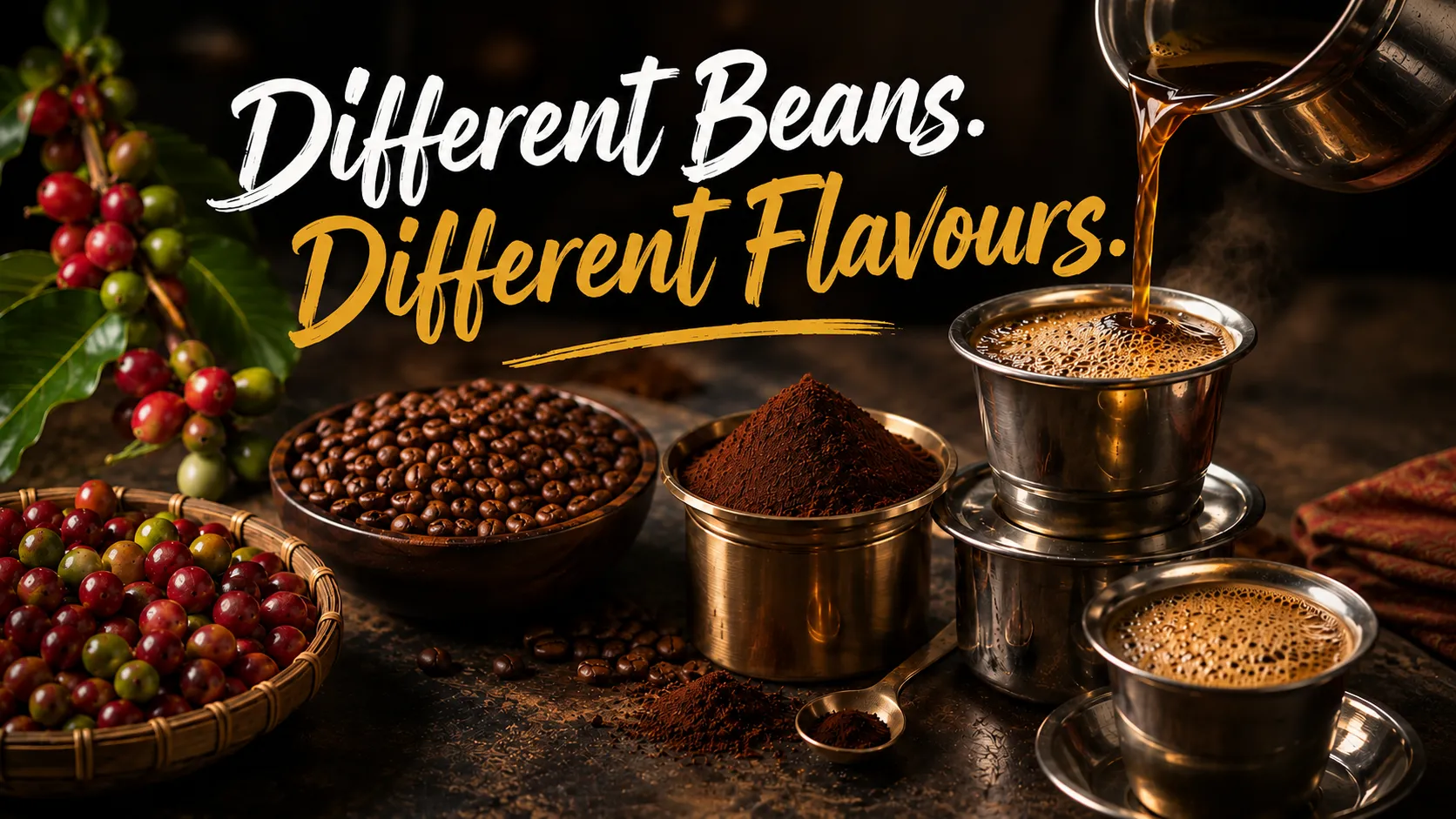
Different Types of Coffee Beans Explained: What Makes Each Coffee Taste Different?
Why does one coffee taste smooth and sweet, while another feels bold, bitter or earthy?
The difference often begins with the coffee bean. Its species, growing conditions, processing and roasting can all influence what eventually reaches your cup.
Most people know Arabica and Robusta, but coffee has other lesser-known varieties too. And surprisingly, the bean itself is only part of the story. From altitude and roasting to chicory and brewing methods, several factors shape the flavour we experience.
Let’s look at what makes different coffees taste so different.
Arabica vs Robusta: What Is the Difference?
Arabica and Robusta are the two coffee species you are most likely to come across.
Arabica generally grows at higher elevations and is known for its more complex aroma and smoother flavour. Depending on where it is grown and how it is processed, Arabica can have fruity, floral, chocolatey or nutty notes.
Robusta, on the other hand, is naturally more resilient and usually grows in warmer, lower-altitude conditions. It contains considerably more caffeine than Arabica and tends to produce a stronger, more earthy and bitter cup with a fuller body.
This is one reason Robusta is often used in espresso blends — it can add body, intensity and crema.
So, if your coffee tastes particularly bold, it doesn’t automatically mean that it has simply been roasted darker. The type of bean could be part of the reason.
The Coffee Bean You Probably Haven’t Heard Of
Arabica and Robusta get most of the attention, but coffee has a few lesser-known characters too.
Liberica produces unusually large beans and can have distinctive woody, smoky or floral notes. It represents only a very small part of the global coffee market, which is one reason you may rarely see it on supermarket shelves.
Then there is Excelsa, known for a particularly interesting combination of flavours. It can have bright, tart and fruity characteristics while also developing deeper, darker notes.
These varieties are a reminder that “coffee flavour” is much broader than the usual bitter-versus-mild description.
Why Does Coffee From Different Countries Taste Different?
The species is only the beginning.
Coffee is an agricultural product, so where it grows matters. Altitude, temperature, rainfall, soil and growing conditions all influence how the coffee cherry develops.
There is also the processing method. Once coffee cherries are harvested, the beans have to be separated from the fruit and prepared for drying. Different processing approaches can influence the flavours that eventually appear in the roasted bean.
Then comes roasting.
A lighter roast can allow more of the bean’s natural characteristics to come through, while a darker roast can create deeper roasted, smoky and bitter flavours.
That means two coffees made from the same species can still taste surprisingly different.
Here’s Something Interesting About South Indian Coffee
If you grew up drinking South Indian coffee, you may already be familiar with another ingredient that changes the character of the brew: chicory.
Traditional Indian filter coffee is made by slowly brewing finely ground coffee through a metal filter to create a concentrated decoction. This is then mixed with hot milk and sugar. Chicory is also commonly used in Indian coffee blends and contributes additional body and bitterness.
That combination is one reason South Indian filter coffee has a different personality from the filter coffee many people are familiar with in Germany.
Interestingly, filter coffee itself is not unfamiliar in Germany. Classic filter coffee has been part of German coffee culture for generations, and hand-prepared filter coffee has seen renewed interest in recent years.
But the Indian filter method is quite different. Instead of brewing a larger pot, a small quantity of finely ground coffee is slowly turned into a strong decoction, which is then combined with hot milk.
And then comes the familiar tumbler-and-davara pour that creates the characteristic frothy top.
What Makes Indian Coffee So Different?
It is not just one ingredient.
It is the combination of the coffee beans, roast, grind size, chicory, slow decoction and hot milk.
That is why Indian filter coffee can taste rich and strong while still feeling smooth and comforting.
For anyone in Germany who is used to filter coffee, espresso or a fully automatic coffee machine, South Indian filter coffee offers a completely different way of brewing and enjoying coffee.
A Closer Look at Degree Café
This traditional style is also the inspiration behind Grün Gesund Degree Café.
The coffee uses freshly roasted beans sourced from estates in Coorg, combined with chicory. Degree Café is available in different traditional ratios, including 60:40, 80:20 and 100% coffee, allowing the balance between coffee and chicory to vary.
The idea is simple: understand what is in your coffee, and you begin to understand why it tastes the way it does.
If you would like to explore the traditional Indian coffee range, you can take a closer look at Grün Gesund Degree Café.
Because sometimes, the most interesting thing about your everyday cup of coffee is what you never noticed before.