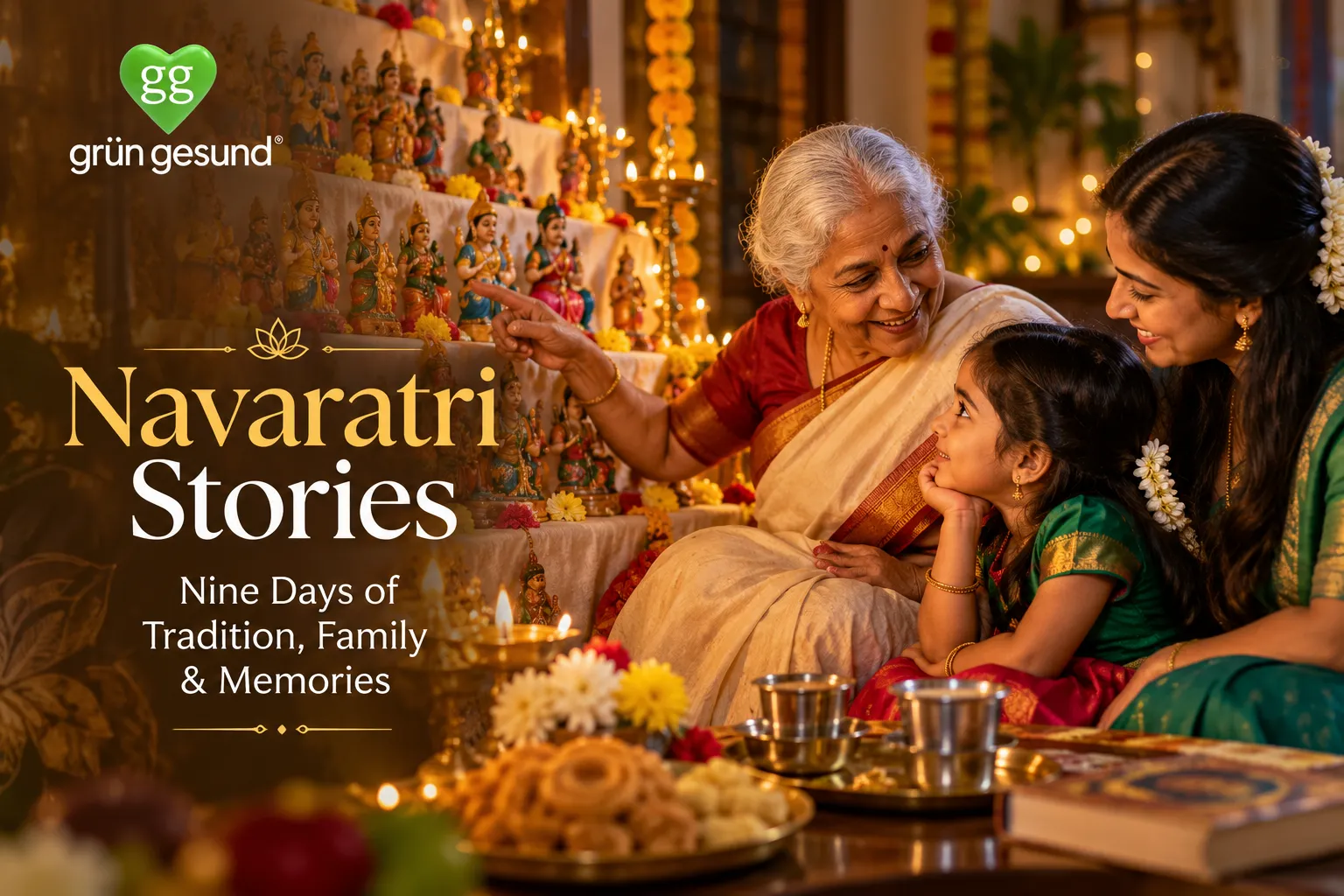
As October Arrives, A Navaratri Story Begins
“Grandma, why do we celebrate Navaratri for nine days?”
I used to ask my grandmother this every year.
She would sit beside the kolu, arrange the dolls, light a small lamp and say, “Because every day has a story.”
I was more interested in the dolls and snacks back then. I never imagined that years later, I would be telling those same stories to my own little one.
Day 1 – Pratipada: Shailaputri
On Pratipada, the first day, Grandma would tell me about Goddess Shailaputri, the first form of Goddess Durga worshipped during Navaratri.
“Every journey needs a beginning,” she would say.
For her, the day was about starting with strength, faith and a clear mind. Today, when I tell my little one about Shailaputri, I tell her that even the biggest journey begins with one small step.
Day 2 – Dwitiya: Brahmacharini
The next evening, Dwitiya, brought the story of Goddess Brahmacharini.
Grandma would talk about patience, dedication and staying strong when something takes time.
“Not everything happens immediately,” she would remind me.
She compared it to growing a plant. You care for it, water it and wait. You cannot make it grow overnight.
I did not understand that lesson then. Today, whenever my little one becomes impatient, I remember Grandma.
Day 3 – Tritiya: Chandraghanta
By Tritiya, the third day, Grandma’s stories became more exciting.
She would tell me about Goddess Chandraghanta and the importance of courage.
“Being brave does not mean you are never afraid,” she would say. “It means you keep going even when you are.”
Her stories made me imagine Goddess Durga standing fearlessly against evil.
Day 4 – Chaturthi: Kushmanda
On Chaturthi, Grandma would tell me about Goddess Kushmanda, associated with energy and creation.
She would point towards the little lamp beside the kolu.
“Even a small light can brighten a dark room,” she would say.
It was her simple way of teaching me that hope, kindness and positivity can begin with something very small.
Day 5 – Panchami: Skandamata
Then came Panchami, associated with Goddess Skandamata, the mother of Lord Skanda.
Grandma would speak about a mother’s love, care and protection.
At that age, I simply listened.
Day 6 – Shashti: Katyayani
On Shashti, Grandma would tell me about Goddess Katyayani, a powerful form of Durga associated with strength and determination.
“Being kind does not mean being weak,” she would tell me.
That sentence stayed with me.
Even today, when I teach my little one to be kind but brave, I think of her.
Day 7 – Saptami: Kalaratri
On Saptami, Grandma would tell me about Goddess Kalaratri.
Her appearance frightened me as a child.
“Why does she look so scary?” I once asked.
“She represents the strength that removes darkness.”
I still remember that answer.
Something may look frightening, she explained, but darkness does not last forever.
Day 8 – Ashtami: Mahagauri
By Ashtami, the eighth day, the house felt different.On Saptami, Grandma would tell me about Goddess Kalaratri.
The lamps seemed brighter, the prayers felt closer, and Navaratri was nearing its end.
Grandma would speak about Goddess Mahagauri and remind me about peace, renewal and gratitude.
“Celebration is more beautiful when you have someone to share it with,” she would say.
Perhaps that was why those evenings became such precious memories.
Day 9 – Navami: Siddhidatri
Finally came Navami, associated with Goddess Siddhidatri.
In many South Indian households, this period is also connected with Saraswati Puja, when books, musical instruments and tools of work are honoured.
Grandma would carefully place my schoolbooks near the prayer space.
“Respect what helps you learn,” she would say.
It was a simple lesson, but one I never forgot.
And Then Came Vijayadashami
On the tenth day came Vijayadashami.
Grandma would smile and say, “Now it is time to begin.”
The day is traditionally considered auspicious for starting something new, especially learning. I remember her holding my hand and helping me write my first letters.
They were crooked and uneven.
“They don’t have to be perfect. You just have to begin.”
Years passed. The dolls went back into their boxes, the notebooks became old, and Grandma’s voice slowly became a memory.
Until one Navaratri, my own little one looked at the kolu and asked,
For a moment, I could hear Grandma again.
So I began telling her the stories.
I told her about Shailaputri and beginnings, Brahmacharini and patience, Chandraghanta and courage, Kushmanda and positive energy, Skandamata and a mother’s love, Katyayani and determination, Kalaratri and overcoming darkness, Mahagauri and peace, and Siddhidatri and knowledge.
She may not remember every name.
She may get distracted or ask for a snack halfway through.
And that is perfectly alright.
Because traditions do not always pass down perfectly. Sometimes they travel through stories, memories, familiar recipes and simple moments shared between generations.
That evening, we shared some familiar Indian snacks and a warm cup of South Indian coffee.
For a moment, it felt as though Grandma was sitting beside us again.
Perhaps that is the quiet beauty of festivals. They bring back people, stories, flavours and memories — and give us a chance to pass them forward.
For Indian families living in Germany and across Europe, familiar everyday flavours can make celebrations feel a little closer to home. Grün Gesund brings familiar Indian pantry favourites into everyday family moments, from dals and oils to snacks and South Indian coffee.
Because sometimes, keeping a tradition alive begins with something very simple:
A story from Grandma.
A question from a child.
And one more generation listening.